Your AI citations are decaying.
We study what survives.
Citation rot is real, and it eats at your bottom line. Dozens of tools can tell you whether you're being cited. Only we can tell you why your content persists and what to change when it doesn't.
Quoted is the only AEO research company studying what makes citations persist across all major AI engines. The result is a prescriptive playbook specific to your company, your vertical, and your buyers.
Now accepting partners for our In-House AEO Research beta program. Limited spots.
SEO rankings compounded—the longer you ranked, the stronger you got. AI citations decay. They rot. And they rot because four forces are moving at once:
The model gets updated
GPT-5.2 cited you. GPT-5.3 doesn't. New version, new preferences, no warning. Every update reshuffles which sources get referenced—and updates ship constantly.
The search index changes
What's in ChatGPT's search index this week is not what was there last week. Pages get added, removed, and re-ranked behind the scenes—independent of the model itself.
A competitor publishes something better
Someone publishes a more useful page on your topic and takes your slot. Unlike SEO, there's no gradual decline—you're cited or you're not. One better page can displace you overnight.
People ask different questions
The same buyer phrases their question differently this month and gets routed to different sources. Small changes in wording change which content gets surfaced.
The critical problem: you can't tell which of these caused your drop.
Without knowing the cause, you can't fix it. Today you call your SEO agency, who shrugs. You check a visibility tool, which shows you the drop but not the why or the what-to-do.
Visibility is becoming commoditized. Prescription is the gap.
Five or more platforms can tell you "are you being cited?" That's table stakes. The question that actually matters—why content persists and what to change—has zero competitors with published methodology. That's where Quoted operates.
Visibility platforms (Profound, Scrunch, BrightEdge Generative AI features) show you the drop. Content agencies rewrite your pages based on best practices. Quoted runs the longitudinal research that tells you why content persists and what specifically to change—backed by data, not intuition.
Longitudinal research, not one-time audits
We treat AI citation optimization as an ongoing research problem, not a project with an end date. Here's why that matters:
We study your citation landscape continuously
Every week, we run a defined set of prompts—the questions your buyers are actually asking AI engines—across ChatGPT, Perplexity, Google AI Overviews, Claude, and Gemini. We record which URLs get cited, in what position, and track how that changes over time.
The data compounds into intelligence
After 4 weeks, you see trends. After 12 weeks, you see patterns. After 6 months, you have a proprietary dataset that tells you exactly which content characteristics persist in citations and which decay. This isn't a report someone writes from intuition—it's statistical analysis from thousands of tracked data points.
Your playbook gets sharper every month
Early recommendations are directional—"content with these characteristics tends to persist." By month three, they're specific—"for these 15 prompts your buyers ask most, here's the exact content gap between you and the brands getting cited." By month six, the playbook is a competitive weapon.
A longitudinal study of what makes content persist in AI citations
AI answer engines are black boxes. Everyone can see what gets cited. We study why it gets cited—and why it stops. Project Glassbox is the only ongoing research initiative focused on the structural and contextual factors that determine citation persistence.
Every week, we track which content gets cited, analyze dozens of structural features across every cited URL, and measure which characteristics correlate with longevity. The result is a growing dataset of citation contributors—the specific content attributes that make AI engines choose one source over another.
Most companies guess at what AI engines want. We've been measuring the contributors—the content features that actually predict whether a citation persists or decays. The findings from Glassbox inform every client playbook we build.
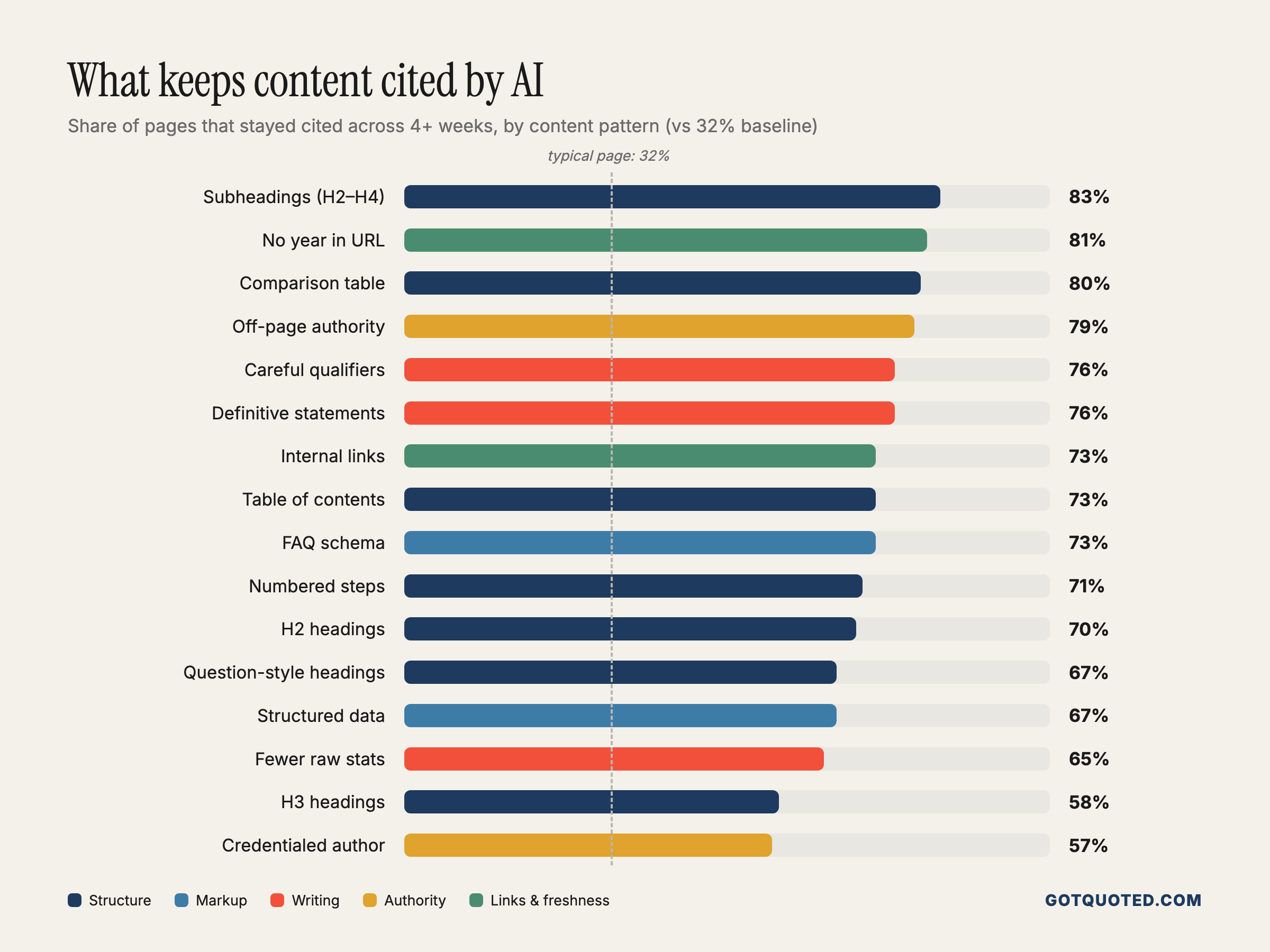
We analyze 40+ content features to find what makes citations stick
Every week, we track which content gets cited, scrape and analyze every cited URL across dozens of structural features, and measure which characteristics correlate with persistence over time. Here's what that research produces:
Illustrative findings. Actual client findings are specific to their vertical and competitive landscape.
A research dashboard and a strategic playbook—both improving every week
Live citation intelligence
A dashboard showing your citation landscape in real time:
- Which of your URLs are currently being cited, by which engines, for which prompts
- Citation persistence trends—what's holding, what's fading, what's new
- Competitor citation tracking—who else shows up when your buyers ask AI
- Content feature analysis—the structural patterns that correlate with citation longevity in your vertical
Updated weekly. Accessible anytime.
Periodic playbook reports
Monthly or quarterly strategic reports with deeper analysis and specific recommendations:
- Which content gaps are costing you citations on high-value prompts
- What your cited competitors are doing structurally that you aren't
- Priority list of content to create or restructure, ranked by citation impact
- Longitudinal trends—how your citation footprint is evolving over time
Written for marketing leaders, not data scientists.
In-House AEO Research Beta Program
Launch your own in-house citation research study—powered by Quoted's infrastructure and methodology. A six-month research engagement designed for content teams and agencies who want to be first movers in AEO intelligence.
Research infrastructure
- Up to 100 tracked prompts across your buyer journey
- Weekly citation tracking across 5 AI engines
- Third-party verified live citation research
- Full access to raw data exports
- Live dashboard with citation persistence and competitor tracking
Strategic deliverables
- Two quarterly deep-dive reports with longitudinal analysis
- Voice and content structure guidelines informed by citation data
- Content feature analysis—what persists and why
- Prioritized content recommendations ranked by citation impact
- Ongoing prompt refinement as your market evolves
Six-month commitment. Longitudinal research requires time to produce statistically meaningful findings. By month three, your playbook is data-backed. By month six, it's a proprietary competitive asset.
The best time to start tracking was six months ago.
The second best time is now.
Every week of data collection makes your playbook more precise. The companies that start tracking AI citations today will have six months of longitudinal intelligence by the time their competitors realize they need it.
This isn't a tool you try for a month and cancel. It's an in-house AEO research program that gets more valuable the longer it runs.